Quick answerAdenoid removal surgery, also called adenoidectomy, is considered when enlarged adenoids cause persistent nasal blockage, mouth breathing, loud snoring, sleep-related breathing problems or repeated ear problems that do not improve with medical treatment. It is usually a short day-care procedure, and most children go home the same day. What Are Adenoids?Adenoids are a collection of lymphatic tissue located behind the nose, in an area called the nasopharynx. Together with the tonsils, they help the immune system respond to germs entering through the nose and mouth during early childhood. Unlike tonsils, adenoids cannot be seen by simply opening the mouth, because they sit higher, behind the nose. They usually grow until about 5–6 years of age and then gradually shrink, becoming very small by the teenage years. What Causes Enlarged Adenoids in Children?Adenoids can become enlarged for several reasons, including: - Repeated colds and upper respiratory infections
- Inflammation that persists after an infection has settled
- Allergic rhinitis and other allergy-related nasal inflammation
- Naturally larger adenoid tissue in some children
Enlarged adenoids do not always need treatment. What matters is whether they are causing symptoms or affecting your child’s breathing, sleep, ears or daily wellbeing. What Are the Symptoms of Enlarged Adenoids?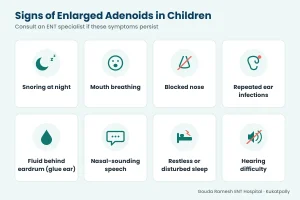 Common symptoms may include: - Persistent nasal blockage
- Breathing through the mouth, especially during sleep
- Snoring or noisy breathing at night
- Restless or disturbed sleep, sometimes with pauses in breathing
- Nasal-sounding (“blocked”) speech
- Repeated ear infections
- Fluid behind the eardrum (glue ear)
- Temporary hearing difficulty
- Daytime tiredness, poor concentration or irritability due to poor sleep
Can Enlarged Adenoids Cause Snoring and Mouth Breathing?Yes. When enlarged adenoids obstruct the back of the nose, a child may find it difficult to breathe comfortably through the nose. This can lead to mouth breathing and snoring, particularly during sleep. In some children, significant obstruction can contribute to sleep-disordered breathing. Persistent loud snoring, restless sleep or pauses in breathing during sleep should be discussed with an ENT specialist. Can Enlarged Adenoids Affect Hearing?Yes, in some children. The adenoids sit close to the openings of the Eustachian tubes, which keep the middle ear ventilated. Enlarged or chronically inflamed adenoids can interfere with this, leading to recurrent middle ear infections, fluid in the middle ear or glue ear. These can cause temporary hearing problems, which may affect speech development and school performance. How Are Enlarged Adenoids Diagnosed?Because adenoids sit behind the nose, they are not visible during a routine throat examination. At our Kukatpally branch, evaluation may include: - A detailed history of your child’s symptoms, sleep and ear problems
- Examination of the ears, nose and throat
- Diagnostic nasal endoscopy – a thin camera gently passed into the nose to see the adenoids directly
- An X-ray of the nasopharynx (soft-tissue lateral view) in selected children
- Hearing tests or tympanometry if ear problems or hearing difficulty are suspected
Treatment is decided only after combining the symptoms with these findings. Do All Enlarged Adenoids Need Surgery?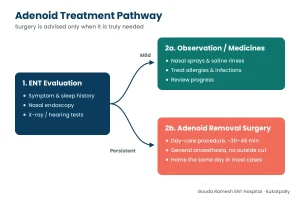
No. Many children with enlarged adenoids do not need surgery. Mild symptoms may improve with observation or medical treatment, depending on the underlying cause. The treatment decision may depend on: - How severe the nasal obstruction is
- Whether sleep is affected
- How frequently ear problems occur
- Whether symptoms persist despite appropriate medical treatment
- The child’s overall ENT examination findings
When Is Adenoid Removal Surgery Recommended?An ENT surgeon may recommend adenoidectomy when a child has: - Ongoing nasal obstruction and persistent mouth breathing
- Loud snoring or sleep-related breathing problems
- Recurrent ear infections or long-standing glue ear
- Recurrent or chronic sinus infections linked to the adenoids
- Symptoms that do not improve with medical treatment
For parents looking for adenoid removal surgery in Kukatpally, the decision should always be based on a proper ENT assessment of your child, not on one symptom alone. What Is an Adenoidectomy and How Is It Performed?Adenoidectomy is the surgical removal of the adenoid tissue. It is performed under general anaesthesia, so your child is asleep and feels no pain during the procedure. The adenoids are reached through the mouth, so there is no external cut on the face or neck. - Your child is given general anaesthesia by an anaesthetist.
- The surgeon reaches the adenoid tissue through the mouth, often under endoscopic guidance for better visibility.
- The enlarged adenoid tissue is removed using a suitable technique (such as curettage, microdebrider or coblation, depending on the case).
- Bleeding is controlled and your child is monitored in recovery until fully awake.
The procedure usually takes around 30–45 minutes. Where needed, it may be combined with another procedure, such as tonsil removal or ear grommet insertion for glue ear. Recovery After Adenoid Removal Surgery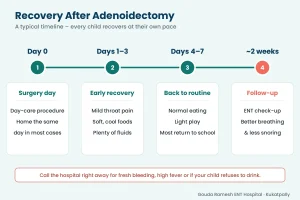
Most children recover quickly. A typical recovery looks like this, although every child is different: - Day of surgery: Most children go home the same day after a few hours of observation (day-care surgery).
- Days 1–3: Mild throat discomfort, a blocked nose, bad breath or a slight change in voice are common and temporary. Pain medicines prescribed by the doctor help.
- Days 4–7: Most children are back to normal eating and playing. Many return to school within about a week.
- Around 2 weeks: A follow-up visit to check healing and improvement in breathing and snoring.
Care tips at home: offer soft, cool foods and plenty of fluids, avoid very hot or spicy food for a few days, keep your child away from crowded places and people with colds, and avoid strenuous play until the doctor advises. Call the hospital immediately if your child has fresh bleeding from the nose or mouth, high fever, refuses to drink, or seems unusually drowsy. Is Adenoid Surgery Safe? Possible RisksAdenoidectomy is one of the most commonly performed surgeries in children and is generally very safe. As with any procedure, there are some risks, which your surgeon will explain: - Bleeding (uncommon)
- Temporary nasal-sounding voice change
- Infection
- Risks related to anaesthesia
- Regrowth of adenoid tissue (rare)
Choosing an experienced ENT surgeon and a well-equipped hospital helps keep these risks low. Adenoid Removal Surgery Cost in Kukatpally – What Affects It?The cost of adenoidectomy varies from child to child. It mainly depends on: - The surgical technique used (conventional, microdebrider or coblation)
- Whether it is combined with tonsil removal or ear grommets
- Pre-operative tests and investigations
- Anaesthesia and day-care charges
- Health insurance coverage – adenoidectomy is usually covered when medically indicated
For an exact estimate for your child, book a consultation or call our Kukatpally branch at +91 95505 74871. Why Choose Gouda Ramesh ENT Hospital, Kukatpally?- Led by Dr. Gouda Ramesh (MS-ENT) with 20+ years of ENT surgical experience
- Dedicated ENT hospital with endoscopic evaluation for accurate diagnosis
- Child-friendly, step-by-step approach – surgery only when it is truly needed
- Clear guidance for parents on recovery, follow-up and care at home
- Conveniently located at Y Junction, beside Balanagar Metro Station, Kukatpally
Medically reviewed by Dr. Gouda Ramesh, MS (ENT) ENT surgeon and founder of Gouda Ramesh ENT Hospital, with 20+ years of experience in ear, nose and throat surgery, including paediatric ENT procedures such as adenoidectomy and tonsillectomy. View our ENT team. Frequently Asked Questions1. What are enlarged adenoids in children?Enlarged adenoids are swollen lymphatic tissues behind the nose. When they become large, they can block nasal airflow and cause mouth breathing, snoring, disturbed sleep and recurring ear problems. 2. At what age is adenoid surgery done?Adenoidectomy is most often performed in children between 2 and 8 years of age, when adenoids are at their largest. The timing depends on how much the symptoms affect the child, not age alone. 3. Can enlarged adenoids cause snoring in children?Yes. Enlarged adenoids partially block the nasal airway, making it harder to breathe through the nose during sleep, which leads to mouth breathing and snoring. 4. Can enlarged adenoids affect hearing?Yes. They can interfere with Eustachian tube function and contribute to middle ear fluid or recurrent ear infections, which can cause temporary hearing difficulty. 5. Do all children with enlarged adenoids need surgery?No. Many children improve with observation or medical treatment. Surgery is considered only when symptoms are persistent or significantly affect breathing, sleep or ear health. 6. Is adenoid removal surgery painful?Your child is under general anaesthesia during surgery and feels no pain. Mild throat discomfort for a few days afterwards is common and is managed with prescribed pain medicines. 7. How long does recovery take after adenoidectomy?Most children go home the same day and return to normal activities and school within about a week. Mild nasal blockage or voice change can last a little longer and settles on its own. 8. Can adenoids grow back after surgery?Regrowth of adenoid tissue can occasionally happen, but it is uncommon. 9. What is the cost of adenoid removal surgery in Kukatpally?The cost depends on the surgical technique, whether other procedures are combined, tests and insurance coverage. Contact Gouda Ramesh ENT Hospital, Kukatpally, for a personalised estimate after evaluation. 10. Where can I get adenoid removal surgery in Kukatpally?Gouda Ramesh ENT Hospital, located at Y Junction beside Balanagar Metro Station, Kukatpally, provides evaluation, endoscopic diagnosis and adenoid removal surgery for children. Book an ENT Consultation in KukatpallyConcerned about your child’s snoring, mouth breathing or constantly blocked nose? Get an expert evaluation at Gouda Ramesh ENT Hospital in Kukatpally. Address: Dr Gouda Ramesh ENT Hospital, Y Junction, KKR Building, 4th Floor, Pillar No. 867, Beside Balanagar Metro Station, Kukatpally, Hyderabad, Telangana – 500072
Phone: +91 95505 74871 Book Appointment WhatsApp Us . | 