
Written by Gouda Ramesh ENT Hospital Medical Editorial Team
Medically reviewed by Dr. Gouda Ramesh, MBBS, MS (ENT) — Chief ENT Surgeon, 20+ years of experience
Last updated: 17 November 2026
Vertigo is the false feeling that you or the room around you is spinning. Most vertigo starts in the inner ear, and the single most common reason is BPPV, where tiny crystals called otoconia slip into the wrong part of the balance organ.
The encouraging part is this: BPPV is usually cured in one or two sittings with a simple head-positioning treatment called the Epley manoeuvre. It is not cured by taking giddiness tablets for months.
This guide explains the real causes, symptoms and treatment of vertigo in plain language, and tells you clearly when spinning is an emergency.
Difference Between Dizziness, Giddiness and Vertigo
Patients often ask what is the difference between dizziness and vertigo. The words get mixed up every day in clinics, and the difference genuinely changes the diagnosis.
In India we also commonly say “giddiness” for almost any unsteady feeling. Knowing the difference between giddiness and vertigo helps your doctor reach the cause faster.
| Feeling | What it feels like | Common triggers | Where it usually comes from |
|---|---|---|---|
| Dizziness | Light-headed, woozy, as if you may faint | Standing up quickly, missed meals, dehydration, anxiety | Blood pressure, blood sugar or general health |
| Giddiness | A vague “head reeling” or weak, unsteady feeling | Tiredness, heat, weakness, stress | A general word patients use for both — needs clarifying |
| Vertigo | True spinning of you or the room around you | Turning over in bed, looking up, bending down | The inner ear balance organ, and rarely the brain |
Key takeaway: If the room truly spins, it is vertigo, and the inner ear is the first place to look. If you only feel weak or faint, the cause is usually elsewhere.
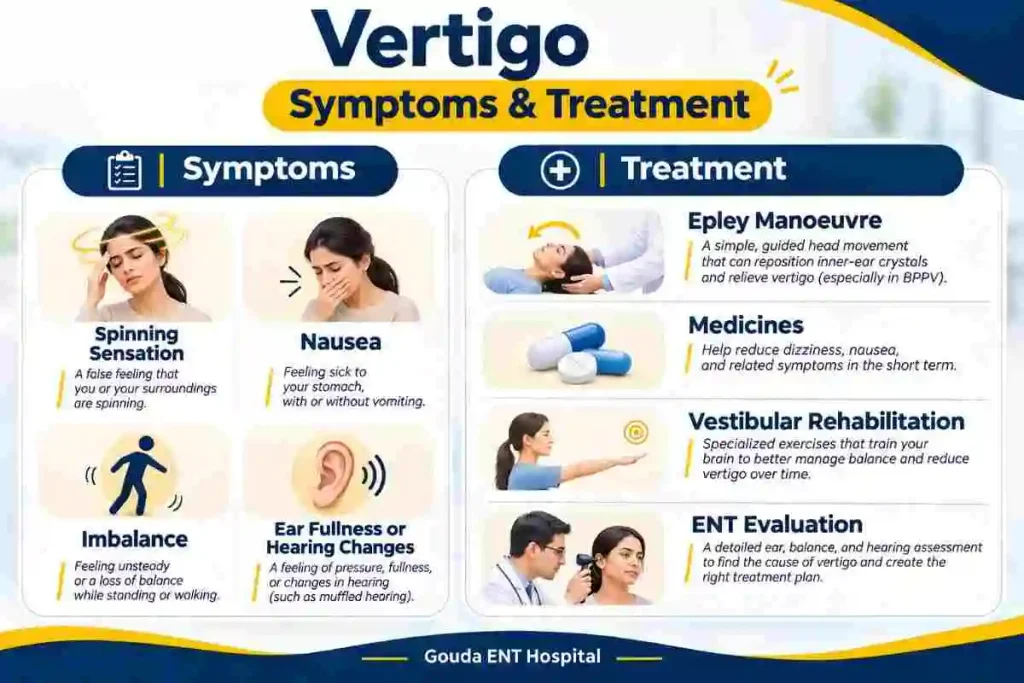
Early Signs and Common Symptoms of Vertigo
Vertigo rarely arrives without warning signs. Most patients notice small changes first and ignore them for weeks.
- Spinning when you move your head — turning in bed, lying down, or looking up at a shelf
- Brief attacks — many patients feel it for only a few seconds at a time
- Loss of balance — leaning to one side, or holding the wall while walking
- Nausea or vomiting — common during a strong attack
- Jerky eye movements — called nystagmus, usually noticed by family members
- Ear symptoms — reduced hearing, a blocked ear feeling, or tinnitus
- Fear of movement — avoiding bending, driving or sleeping on one side
Two details matter most to your ENT doctor: how long each attack lasts, and whether your hearing has changed. Together they point to the cause.
Inner Ear Problems Causing Vertigo
Your balance comes from the vestibular system, a set of fluid-filled tubes called the semicircular canals inside the ear. When this system sends a wrong signal, your brain reads it as movement.
Most inner ear problems causing vertigo fall into four groups.
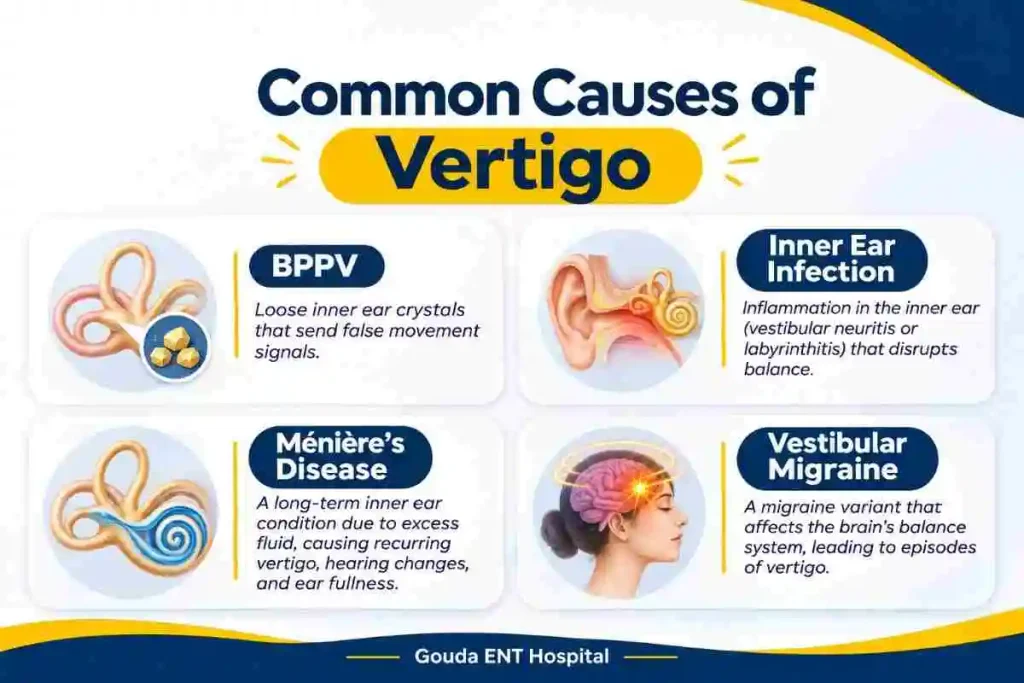
1. BPPV (Benign Paroxysmal Positional Vertigo)
The most common cause by far. Small calcium crystals called otoconia come loose and float into the semicircular canals, where they disturb balance every time your head moves.
Attacks are short, often just seconds, and are set off by rolling over in bed or looking up. Hearing stays normal in BPPV. It becomes more common as we get older, and in elderly patients it is an important and frequently missed cause of falls.
2. Inner Ear Fluid Causing Vertigo (Ménière’s Disease)
Here the pressure of fluid inside the inner ear rises. Patients describe attacks lasting twenty minutes to several hours, not seconds.
Ménière’s disease usually comes with three ear symptoms together: fluctuating hearing loss, ringing in the ear, and a feeling of fullness or pressure. The pattern over months is what confirms it.
3. Labyrinthitis and Vestibular Neuritis
These follow a viral illness such as a cold or fever. Vertigo starts suddenly, is severe, and lasts for days rather than seconds, usually with vomiting.
The difference is simple. In vestibular neuritis only balance is affected. In labyrinthitis, hearing is affected as well.
4. Middle Ear Problems
A long-standing middle ear infection, a hole in the eardrum, or discharge from the ear can also disturb balance. These need direct ear examination, not tablets.
Key takeaway: Short spinning with normal hearing suggests BPPV. Long attacks with changing hearing suggest inner ear fluid. Days of spinning after a viral fever suggests neuritis.
How Vertigo Is Diagnosed
For vertigo, a careful history and examination tell the doctor more than any scan. Expect questions about attack length, triggers, hearing and medicines you take.
- Dix-Hallpike test — your head is moved into a set position while the doctor watches your eyes. It confirms BPPV and shows which ear and which canal is involved.
- Ear and balance examination — the eardrums, eye movements, walking and balance are all checked.
- Audiometry — a hearing test, done when hearing symptoms are present.
- Scans, only when needed — an MRI is not routine. It is advised when the examination suggests a cause outside the ear.
Vertigo Cure and ENT Treatments
The honest answer on cure depends on the cause. BPPV can genuinely be cured. Ménière’s disease is controlled rather than cured.
Epley Manoeuvre (Canalith Repositioning)
For BPPV, treatment is a guided sequence of head and body positions that moves the loose crystals back out of the canal. It is done in the consulting room and takes only a few minutes.
Most patients improve after one or two sittings. This is a treatment, not a tablet, which is why months of medication often change nothing.
Targeted Medication
Medicines genuinely help in the first few days of a severe attack, mainly to settle spinning and vomiting. Used for weeks or months, they can actually slow recovery by stopping the brain from adjusting.
Medication is also used differently for each cause. Ménière’s disease, for example, is managed with salt reduction and specific medicines rather than with the same tablets used for BPPV.
Vestibular Rehabilitation Therapy (VRT)
VRT is a planned set of eye, head and balance exercises that retrain your brain to cope with a weak balance signal. It is well supported by evidence for one-sided inner ear balance problems such as vestibular neuritis.
VRT is prescribed and progressed by a specialist. The exercises are matched to your test findings, not picked from a video.
Vertigo in Both Ears: Treatment Approach
When both ears are affected, patients feel constant unsteadiness and blurring when they move their head, rather than short spinning attacks. Common reasons include certain long-term medicines that affect the inner ear, and balance loss on both sides after infection.
Vertigo in both ears treatment relies far more on vestibular rehabilitation than on manoeuvres or tablets. Reviewing any medicines that may be harming the inner ear is an important early step, and must be done with your doctor.
Surgery
Surgery for vertigo is uncommon. It is considered only for a small number of patients whose symptoms do not settle with everything else.
Safe Home Relief Tips
These steps help you stay safe during an attack. They support treatment, they do not replace diagnosis.
- Sit or lie down immediately when spinning starts, and stay still until it passes
- Move your head slowly, especially when getting out of bed
- Sleep with your head slightly raised on an extra pillow
- Keep a night light on, since poor light makes balance worse
- Drink enough water and avoid skipping meals
- Do not drive, ride a two-wheeler, cook at a stove, or climb stairs or ladders while symptoms are active
- Remove loose mats and clutter at home, which matters most for elderly patients at risk of falls
Important caution: Do not attempt the Epley manoeuvre or any head-positioning exercise at home from a video. Done on the wrong ear or the wrong canal, it can worsen symptoms, and it is unsafe for anyone with neck problems or a suspected cause outside the ear. These manoeuvres should be performed or taught by a specialist after proper testing.
When to Seek Emergency Care (Red Flag Symptoms)
Go to the nearest hospital immediately — do not wait for an appointment — if vertigo comes with any of the following:
- A sudden, severe headache unlike your usual headache
- Double vision or sudden loss of vision
- Slurred speech or difficulty finding words
- Weakness or numbness of the face, arm or leg
- Fainting, or loss of consciousness
- Inability to walk or sit upright without support
- Sudden loss of hearing in one ear
These signs can point to a problem in the brain rather than the ear. They need assessment the same day, not an outpatient appointment.
When Should You See an ENT Specialist?
Book a consultation if spinning returns whenever you turn in bed or look up, if it lasts more than a few days, if your hearing has changed, if you have had a fall, or if tablets have not helped over several weeks.
Frequently Asked Questions
What is the main cause of vertigo?
BPPV is the most common cause. Loose crystals in the inner ear trigger brief spinning when you move your head, lasting seconds to a minute, with no change in hearing. It is confirmed by a simple positional test in the consulting room.
Can vertigo be cured permanently?
It depends on the cause. BPPV can be cleared completely with repositioning manoeuvres, though it may return later and can be treated again. Conditions such as Ménière’s disease are controlled with long-term management rather than permanently cured.
Why do I feel vertigo when I lie down?
Spinning that starts when you lie down, turn over or sit up is the classic pattern of BPPV. The change in head position moves the loose crystals inside the balance canal. This pattern is one of the most useful clues your doctor has.
Is vertigo a sign of something serious?
Most vertigo comes from the inner ear and is not dangerous, though it is distressing and raises the risk of falls. A small number of cases come from the brain. Vertigo with slurred speech, weakness, double vision or fainting needs emergency care the same day.
What is the fastest way to stop a vertigo attack?
During an attack, sit or lie still, keep your eyes fixed on one point, and avoid sudden head movements until it passes. For lasting relief, the fastest route is an accurate diagnosis, because BPPV often settles after one correctly performed manoeuvre.
Consult an ENT Specialist for Vertigo
If spinning keeps returning, an ENT evaluation will tell you what is actually causing it. At Gouda Ramesh ENT Hospital we have treated more than 3,00,000 patients and performed over 30,000 ENT surgeries, with a 4.7 Google rating across our branches.
Care is led by Dr. Gouda Ramesh, supported by Dr. S. Nandini (MS-ENT) and Dr. J. Lingaiah (MS-ENT). You can read more about our vertigo treatment and the full range of ear treatments we offer.
For vertigo treatment in Hyderabad and Warangal, consult us at any of our three branches:
- Kukatpally, Hyderabad — Y Junction, Beside Balanagar Metro Station. To meet a vertigo specialist in Kukatpally, call +91 95505 74871
- Chandanagar, Hyderabad — Opposite VRK Silks, Chanda Nagar. To meet a vertigo specialist in Chandanagar, call +91 99851 71182
- Hanamkonda, Warangal — Bus Stand Road, Beside Asian Sridevi Mall. To meet a vertigo specialist in Hanamkonda, call +91 91778 12783
Book a consultation and get an accurate diagnosis rather than another course of tablets.
About the medical reviewer: Dr. Gouda Ramesh, MBBS, MS (ENT)
Chief ENT Surgeon and founder of Gouda Ramesh ENT Hospital, with 20+ years of experience in ENT and head & neck surgery. He practises across the hospital’s Kukatpally, Chandanagar and Hanamkonda branches. View full profile.
References
- Bhattacharyya N, Gubbels SP, Schwartz SR, et al. Clinical Practice Guideline: Benign Paroxysmal Positional Vertigo (Update). American Academy of Otolaryngology–Head and Neck Surgery Foundation. entnet.org
- MSD Manual Professional Edition. Benign Paroxysmal Positional Vertigo. msdmanuals.com
- National Institute on Deafness and Other Communication Disorders. Balance Disorders. nidcd.nih.gov
- McDonnell MN, Hillier SL. Vestibular rehabilitation for unilateral peripheral vestibular dysfunction. Cochrane Database of Systematic Reviews. cochrane.org
- NHS. Vertigo. nhs.uk
Medical disclaimer. This article is for general information and patient education. It is not a substitute for examination, diagnosis or treatment by a qualified doctor, and it is not personalised medical advice. Vertigo has several possible causes, and the right treatment differs from patient to patient depending on examination findings.
Do not start, stop or change any medication on the basis of this article, and do not attempt head-positioning manoeuvres at home without being assessed and shown how. Please consult an ENT specialist or your treating doctor. If you develop vertigo with slurred speech, double vision, weakness, numbness, a severe headache, fainting or sudden hearing loss, seek emergency care at your nearest hospital immediately.