
Written byGouda Ramesh ENT Hospital content team
Medically reviewed byDr. Gouda Ramesh, MBBS, MS (ENT)
Last reviewed[13/11/2026]
Are you frequently experiencing a blocked nose, facial pressure, headaches or recurring sinus infections? These symptoms may be associated with sinusitis, a condition that can affect your breathing, sleep and daily comfort.
Sinus problems are among the most common reasons patients visit an ENT hospital in Hanamkonda. Dusty conditions, seasonal changes and untreated nasal allergies all contribute, and many patients manage symptoms for months before seeking evaluation.
That delay matters. Sinusitis may be viral, bacterial, allergic or structural, and each needs a different approach. Accurate diagnosis is what tells you which one you are dealing with.
Urgent symptoms — do not wait for an appointment
Swelling or pain around the eye, any change in vision, severe headache with fever or neck stiffness, or confusion require emergency care. Go to your nearest hospital immediately.
What Is Sinusitis?
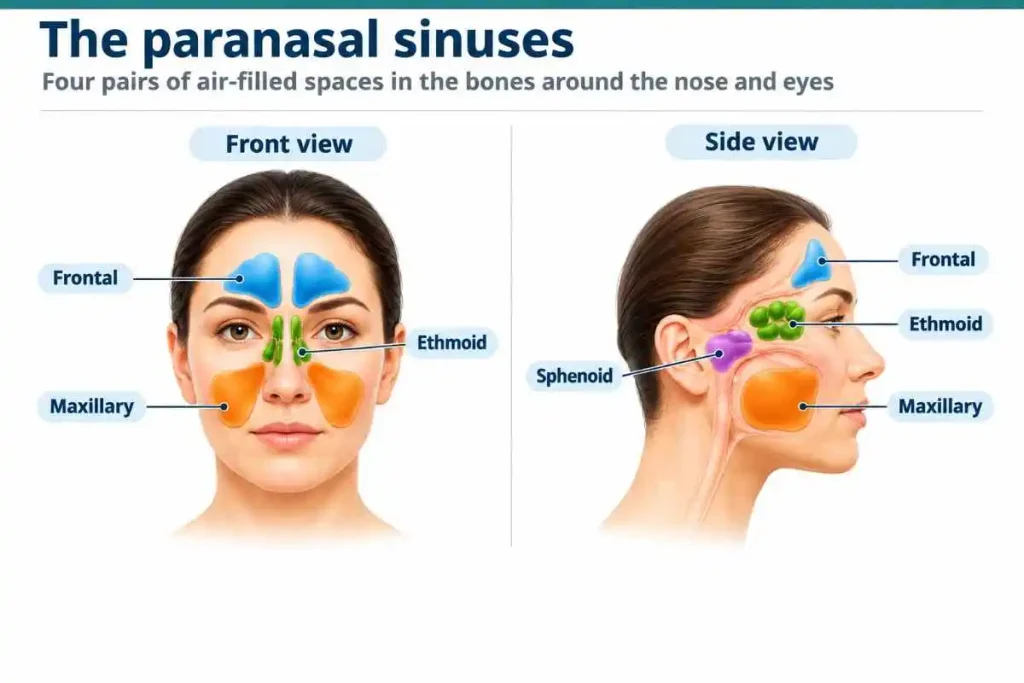
Your sinuses are hollow, air-filled spaces in the bones around the nose, cheeks, forehead and eyes. They are lined with a membrane that produces mucus, which drains into the nose through small openings.
Sinusitis occurs when this lining becomes inflamed and swollen. The openings narrow, mucus is trapped, and pressure builds up — producing the familiar blocked nose, facial heaviness and thick discharge. Because the nasal passages and sinuses are almost always inflamed together, ENT specialists prefer the term rhinosinusitis.
What Are the Common Symptoms of Sinusitis?
- Nasal congestion — difficulty breathing through the nose, often on both sides
- Facial pain or pressure — across the cheeks, forehead or between the eyes, worse on bending forward
- Thick nasal discharge — which may be yellow or green
- Reduced sense of smell — often with reduced taste
- Headache — usually a dull, heavy ache rather than sharp pain
- Postnasal drip — mucus trickling down the throat, causing irritation
- Cough and disturbed sleep — typically worse at night when lying flat
What Causes Sinusitis?
Sinusitis develops when something blocks normal sinus drainage. In many patients more than one factor is present.
Infections
Most acute sinus infections follow a common cold and are viral. In a smaller proportion a bacterial infection develops afterwards, and distinguishing the two changes the treatment entirely.
Allergies
One of the most common causes of recurring sinus problems. Dust, pollen, smoke and weather changes keep the nasal lining swollen, repeatedly obstructing drainage. Treating the sinuses without addressing the allergy usually means the problem returns.
Nasal polyps
Soft, non-cancerous swellings arising from an inflamed nasal lining. When large, they physically block the sinus openings and nasal airway.
Structural problems
A deviated septum, narrow drainage pathways or previous nasal injury restrict airflow and do not respond to medication alone. Dental infection of the upper teeth, dust exposure at work and asthma also raise the risk.
Types of Sinusitis
Sinusitis is classified by how long symptoms last and how often they return, and this guides the whole treatment plan.
| Type | Duration | What it generally indicates |
|---|---|---|
| Acute | Less than 4 weeks | Usually follows a cold and is most often viral. Many cases settle with supportive care. |
| Subacute | 4 to 12 weeks | Recovery slower than expected. Worth a medical review. |
| Chronic | 12 weeks or longer | Persistent inflammation rather than simple infection. Needs ENT evaluation. |
| Recurrent acute | 4 or more episodes a year | Suggests an underlying allergy or structural cause. |
Chronic sinusitis requires at least two of four main symptoms — nasal blockage, discharge, facial pain or pressure, and reduced smell — for twelve weeks or more, plus objective evidence of inflammation on examination or imaging.
How Is Sinusitis Diagnosed?
Medical history and ENT examination
How long symptoms have lasted, how often they recur, what triggers them, and what you have already tried — followed by examination of the nose, throat and ears for swelling, discharge, polyps or septal deviation.
Nasal endoscopy
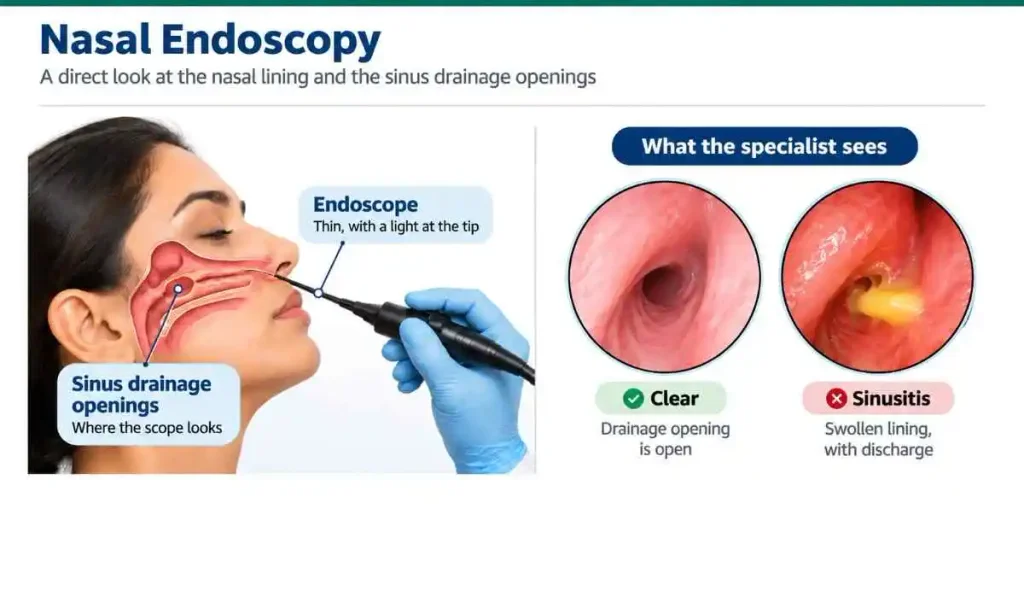
A thin endoscope passed gently into the nose gives a direct view of the nasal lining and drainage openings, revealing polyps, pus and narrowing that an external examination cannot. It takes a few minutes in the consulting room.
Imaging, when clinically necessary
A CT scan is not routine. It is advised when chronic sinusitis needs confirming, the diagnosis is unclear, complications are suspected, or before surgery. Plain sinus X-rays are no longer considered reliable.
Sinus Treatment Options in Hanamkonda
Treatment depends on the cause, duration and severity of symptoms. Most patients improve with medical management, and not every patient needs antibiotics or surgery.
Saline nasal irrigation
Rinsing the nasal passages with sterile saline clears mucus and irritants and supports drainage. It is inexpensive and can be continued long term. Use distilled, sterile or previously boiled and cooled water, never water from the tap.
Intranasal corticosteroid sprays
These reduce the inflammation that keeps sinus openings blocked and are well supported by evidence. They act gradually, which is why many patients stop them too early. Used consistently over several weeks, they form the foundation of medical treatment.2,3
Allergy management
Antihistamines, allergen avoidance and, for selected patients, longer-term allergy treatment. Where allergy is the driver, this often breaks the cycle of recurring infections.
Antibiotics, only when clinically indicated
Most acute sinus infections are viral and do not benefit from antibiotics. A bacterial infection is suspected when symptoms show no improvement for at least ten days, or when they improve and then clearly worsen again within ten days. Even then, current international guidance supports a period of watchful waiting for uncomplicated cases, decided jointly between patient and doctor.1,4
A note on self-medication
Repeated antibiotic courses taken without consultation are a common reason sinus problems continue for months. In chronic sinusitis the problem is inflammation rather than active infection, which is why antibiotics alone do not resolve it.
Management of nasal polyps
Smaller polyps often respond to intranasal steroids, sometimes with a short course of oral steroids. Larger polyps obstructing the airway may need surgical removal.
Functional Endoscopic Sinus Surgery (FESS)
FESS is considered for selected patients whose symptoms persist despite medical treatment. It is performed entirely through the nostrils using an endoscope, with no external incisions or facial scars, to open the natural drainage pathways so the sinuses can ventilate normally.5
At our Hanamkonda branch, sinus surgery is performed as micro-debrider assisted FESS, which removes diseased tissue precisely while preserving healthy lining. Where a deviated septum contributes, septoplasty may be done in the same sitting.
When Is Sinus Surgery Necessary?
Surgery is never the first step. It is considered after a proper trial of medical treatment, generally in these situations:
- Chronic sinusitis persisting despite several weeks of appropriate treatment
- Nasal polyps obstructing the drainage pathways or nasal airway
- A significantly deviated septum restricting airflow
- Recurrent infections with an identified structural cause
- Fungal sinus disease, or a growth requiring biopsy
Setting realistic expectations
Surgery opens blocked drainage pathways and relieves symptoms for most suitable patients, but does not remove the underlying tendency towards inflammation. Patients with allergy or polyps usually continue nasal sprays afterwards. Outcomes vary, and your surgeon will explain what is realistic.
When Should You Consult an ENT Specialist for Sinus Problems?
Consider consulting an ENT specialist in Hanamkonda if you have:
- Symptoms continuing beyond ten days without improvement
- Symptoms that improve and then worsen again
- Four or more episodes of sinus infection in a year
- Symptoms persisting twelve weeks or longer
- Nasal blockage disturbing your sleep or daily activities
Seek medical care the same day if you notice
- Swelling, redness or pain around the eye, or any change in vision
- Severe headache with neck stiffness, confusion or high fever
- Symptoms strictly on one side, particularly with repeated nosebleeds3
- Facial numbness, or visible swelling of the cheek or forehead
These are uncommon but need urgent assessment.
Sinus Care at Gouda Ramesh ENT Hospital in Hanamkonda
Our Hanamkonda branch on Bus Stand Road serves patients across Hanamkonda, Warangal and Kazipet, offering consultation, nasal endoscopy and the full range of nose and sinus treatments available across our hospital, including micro-debrider sinus surgery where required. Care is led by Dr. Gouda Ramesh, supported by Dr. S. Nandini and Dr. J. Lingaiah.
Read more on our nose and sinus treatments page, on sinusitis with polyps treatment, and about the team on the Hanamkonda branch page.
Gouda Ramesh ENT Hospital — Hanamkonda Branch
Address#7-1-64, Bus Stand Road, Beside Asian Sridevi Mall, Opposite Kalyani Hospital, Sai Nagar, Hanamkonda, Telangana 506001
Phone+91 91778 12783
Timings:Monday to Saturday, 9:30 AM to 9:00 PM
Closed on Sunday
PaymentAarogyasri and EHS reimbursement, cashless claims, cards and UPI
Struggling with recurring sinus infections, nasal blockage or facial pressure? Consult the ENT specialists at Gouda Ramesh ENT Hospital in Hanamkonda for an accurate diagnosis.Call +91 91778 12783 Book a consultation
Frequently Asked Questions About Sinus Treatment in Hanamkonda
No single treatment fits every case. For most patients, saline irrigation, intranasal corticosteroid sprays and treating any underlying allergy are effective. Antibiotics are used only where bacterial infection is genuinely suspected.
Yes. Most patients are managed without surgery, through medication, allergy management and nasal care. Surgery is considered only when these have not helped, or where nasal polyps or a deviated septum are present.
An ENT specialist, also called an otolaryngologist. They examine the nasal passages and sinus drainage pathways directly using nasal endoscopy, and manage both the medical and surgical treatment of sinusitis.
How do I know whether I have chronic sinusitis?
When at least two of four main symptoms — nasal blockage, nasal discharge, facial pain or pressure, and reduced smell — continue for twelve weeks or longer, with inflammation confirmed on nasal endoscopy or a CT scan.
No. Only a small proportion of patients need it — after medical treatment has not given adequate relief, or where there is a structural cause that medication cannot correct.
If symptoms last beyond ten days without improving, improve and then worsen again, recur four or more times a year, or continue past twelve weeks. Swelling around the eye or vision changes need same-day attention.
Conclusion
Sinusitis is common and, in most cases, manageable. Persistent nasal blockage, facial pressure and recurring infections are not something to tolerate or self-treat indefinitely.
Accurate diagnosis determines everything that follows — for most patients, medical management and nasal care; for a smaller number, endoscopic sinus surgery. If your symptoms keep returning, an ENT evaluation will tell you what is causing them and what will help.
About the medical reviewerDr. Gouda Ramesh, MBBS, MS (ENT)
Chief ENT Surgeon and founder of Gouda Ramesh ENT Hospital, with 20+ years of experience in ENT and head & neck surgery. He practises across the hospital’s Kukatpally, Chandanagar and Hanamkonda branches and performs endoscopic sinus, ear and airway surgery. View full profile.
Branches Kukatpally and Chandanagar, Hyderabad · Hanamkonda, Warangal
References
- American Academy of Otolaryngology—Head and Neck Surgery Foundation. Clinical Practice Guideline: Adult Sinusitis Update. Otolaryngology–Head and Neck Surgery, 2025. entnet.org
- American Academy of Family Physicians. Chronic Rhinosinusitis. American Family Physician. aafp.org
- Canadian Medical Association Journal. Diagnosis and management of chronic rhinosinusitis. CMAJ, 2025. cmaj.ca
- National Institute for Health and Care Excellence. Sinusitis (acute): antimicrobial prescribing — information for the public (NG79). nice.org.uk
- NHS. Sinusitis (sinus infection). nhs.uk
Medical disclaimer. This article is for general information and patient education. It is not a substitute for examination, diagnosis or treatment by a qualified doctor, and it is not personalised medical advice. Sinus symptoms have several possible causes and the right treatment differs from patient to patient depending on examination findings.
Do not start, stop or change any medication on the basis of this article. Please consult an ENT specialist or your treating doctor. If you develop swelling or pain around the eye, changes in vision, a severe headache with fever or neck stiffness, or confusion, seek emergency care at your nearest hospital immediately rather than waiting for an appointment.