
Quick answer: If you sneeze repeatedly every morning, your nose runs clear and your eyes itch — but you never run a fever and it never quite goes away — it is more likely to be allergic rhinitis than a cold. A cold usually clears in seven to ten days. An allergy tends to return every time you meet the trigger. Allergic rhinitis is very treatable, but it needs the trigger identified rather than another course of antibiotics.
Dust Allergy vs Common Cold: How to Tell the Difference
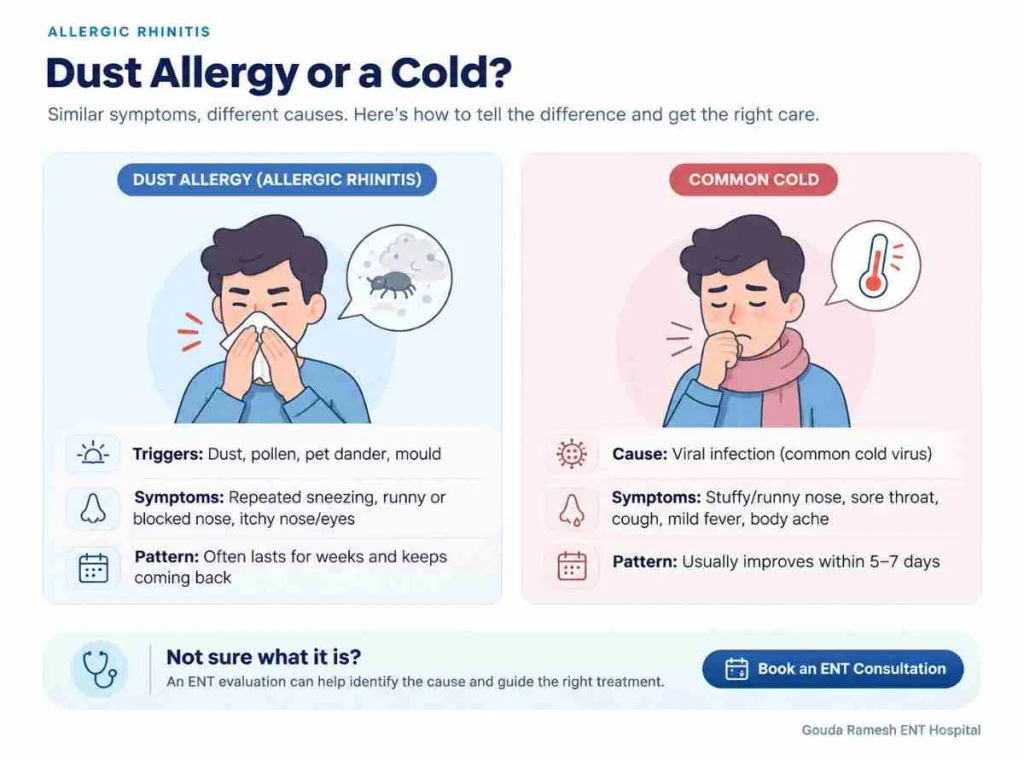
This is the question most patients arrive with, so it is worth settling first. No single row below is decisive on its own — it is the overall pattern that matters.
| Allergic rhinitis | Common cold | |
|---|---|---|
| How it starts | Quickly after meeting the trigger, where the exposure is occasional. Where the trigger is present all the time, such as house dust, symptoms can feel constant instead | Gradually, over a day or two |
| How long it lasts | Weeks or months, or returns on exposure | Usually seven to ten days |
| Fever | Not caused by allergy | Common, particularly in children |
| Nasal discharge | Usually thin, clear and watery | Often starts clear and becomes thicker |
| Itching | Usually prominent — nose, eyes, palate, throat | Unusual |
| Sneezing | Often in repeated bursts | Occasional |
| Body ache, sore throat | Not typical, though post-nasal drip can irritate the throat | Common |
| Contagious | No | Yes |
| Pattern | Often the same time of day, or in the same place | No pattern; others at home often fall ill too |
Two things worth adding. First, the two can happen together — someone with allergic rhinitis can also catch a cold, and in children the two often overlap, which is part of why the picture gets confusing. Second, thick or coloured nasal discharge does not by itself mean a bacterial infection or a need for antibiotics; mucus commonly changes colour during an ordinary viral cold.
The pattern row is the most useful one. Sneezing on waking, or every time you sweep the house, or only at the office, points towards allergy rather than infection. A “cold” that has lasted six weeks is not a cold.
What Is Allergic Rhinitis (Dust Allergy)?
Allergic rhinitis is an immune reaction in the lining of the nose. When you inhale a substance your body has become sensitised to — house dust, pollen, mould — the lining releases histamine and other chemicals. These cause the blood vessels to swell and the glands to produce watery fluid. Sneezing, itching, a running nose and blockage follow.
It is common and frequently mistaken for repeated infection, which matters because antibiotics do nothing for it.
Common Symptoms of Dust Allergy
- Bouts of sneezing, often worst in the first hour after waking
- Clear, watery discharge from the nose
- Blocked nose, sometimes alternating between the two sides
- Itching in the nose, roof of the mouth, throat or ears
- Red, itchy, watering eyes
- Post-nasal drip and persistent throat clearing or cough
- Reduced sense of smell
- Disturbed sleep, daytime tiredness, difficulty concentrating
Not everyone has all of these, and severity varies widely. In children, look also for constant mouth breathing, snoring, rubbing the nose upwards with the palm, dark circles under the eyes, and falling attention at school.
Common triggers in Hyderabad
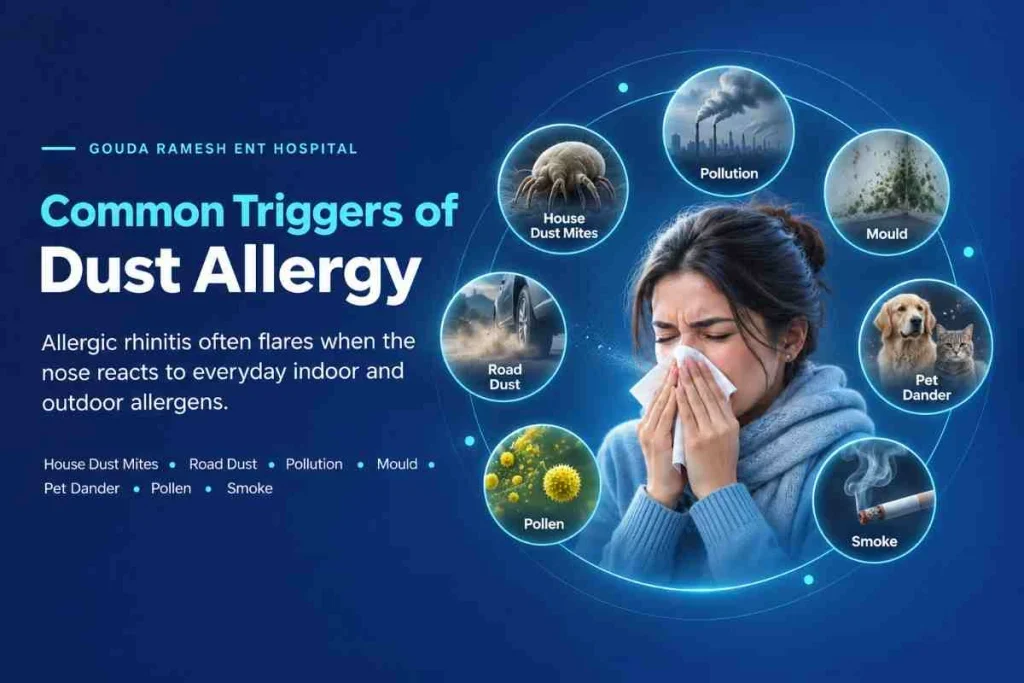
Allergic rhinitis is often called hay fever, which can mislead here. In the patients we typically see, indoor triggers matter more than pollen:
- House dust mites — among the most common triggers. They live in mattresses, pillows, upholstery and soft toys, which is one reason symptoms often peak on waking and after bed-making.
- Construction and road dust — a widespread exposure across the city, and a common reason symptoms begin after moving house or changing commute.
- Vehicle exhaust and air pollution, which can both trigger symptoms and worsen existing allergy.
- Mould spores — damp walls and bathrooms, more of a problem during and after the monsoon.
- Cockroach allergen — an indoor trigger that is easy to overlook.
- Pet dander from cats and dogs.
- Pollen from grasses and trees — seasonal, and generally less dominant here than the indoor triggers above.
- Smoke — cigarettes, incense, mosquito coils and cooking smoke act as irritants on an already sensitised nose.
Flares are commonly reported in the weeks after Diwali, when smoke adds to an already dusty period, and again through the dry, cool months from November to February — which is often when patients assume they have caught a winter cold that will not clear.
Seasonal vs Year-Round Allergic Rhinitis
If your symptoms come and go with a particular season, the trigger is more likely outdoor — pollen or mould. If they are present most days all year, an indoor trigger is more likely, with dust mites high on the list. This distinction changes what we ask you to do at home, so it is worth noticing which pattern fits you before your appointment.
Can a Runny Nose Have Causes Other Than Allergy?
Some patients have all the symptoms of allergic rhinitis with no allergy behind them. In vasomotor rhinitis, the nasal lining overreacts to temperature changes, strong smells, spicy food or air conditioning rather than to an allergen. Itching and eye symptoms are usually absent, and allergy testing is negative. A deviated nasal septum can also cause persistent one-sided blockage that is mistaken for allergy. Telling these apart matters, because the treatment differs.
Why it is worth treating properly
Clinical guidance asks doctors to check patients with allergic rhinitis for related conditions, because these are known to occur alongside it:
- Sinusitis — swelling can obstruct sinus drainage, and allergic rhinitis is associated with recurrent sinus problems and, in some patients, nasal polyps.
- Ear problems — eustachian tube blockage is associated with fluid behind the eardrum and middle-ear infection. In young children, hearing that is dulled for long periods can affect speech development.
- Adenoid enlargement in children, which is associated with persistent nasal allergy, mouth breathing and snoring.
- Asthma — the upper and lower airways are closely linked, and poorly controlled nasal allergy can make asthma harder to control.
- Eye symptoms, eczema and disturbed sleep, which commonly accompany it.
How Is Allergic Rhinitis Diagnosed?
Allergic rhinitis is diagnosed clinically — from your history and examination rather than from a test. What the symptoms are, when they occur, where you were, and whether allergy, asthma or eczema run in the family will tell your ENT specialist most of what is needed. Beyond that:
- Nasal examination and endoscopy to see the lining directly, and to check for polyps, a deviated septum or enlarged turbinates.
- Allergy testing — a skin prick test or a blood test for specific IgE. This is advised when symptoms have not responded to initial treatment, or when immunotherapy is being considered, rather than routinely at the first visit. [CONFIRM: in-house or referred?]
- Imaging is not routinely needed, and guidelines specifically advise against routine scanning for straightforward allergic rhinitis.
Allergic Rhinitis Treatment: How Can You Manage Dust Allergy?
For how treatment is delivered at our hospital, see allergic rhinitis treatment at Gouda ENT. In outline:
Reducing exposure
Where a trigger is known, reducing exposure to it is worth doing, and for most patients here that means dust mite control. Wash bedding weekly in hot water, use zipped mite-proof covers on mattress and pillows, keep soft toys off the bed, replace heavy curtains and carpets where you can, and clean air-conditioner filters regularly. Use a damp cloth rather than a dry duster, and wear a mask when sweeping or during construction work nearby.
Be realistic about this. Single measures on their own often make only a modest difference, and several used together work better than any one alone. Avoidance supports treatment; it rarely replaces it.
Saline Nasal Irrigation for Allergy Relief
Rinsing the nose with saline helps wash allergens off the lining and is a reasonable first step for most people.
Important — the water you use matters. Never rinse your nose with water straight from the tap. Use sterile or distilled water, or water that has been boiled and then cooled. Rinse devices should be cleaned after every use and allowed to dry. Tap water is safe to drink but is not sterile, and using it in the nose carries a small risk of serious infection.
Medicines for Allergic Rhinitis
For mild or occasional symptoms, particularly where sneezing and itching dominate, non-sedating antihistamine tablets work well. Older sedating antihistamines can cause marked drowsiness — take care with driving, machinery and schoolwork, and ask your pharmacist or doctor if you are unsure which type you have been given.
Where symptoms are affecting your daily life, intranasal corticosteroid sprays are the most effective treatment available, and clinical guidelines recommend them as first-line for this group. Two things are commonly got wrong:
- They need time. Regular daily use for two to four weeks is needed before the full benefit appears. Patients who try a spray for three days and stop conclude wrongly that it does not work.
- They need correct technique. Angle the spray slightly outward, toward the ear on the same side — not straight up the nose — and do not sniff hard afterwards.
Mild nasal irritation, dryness or occasional nosebleeds can occur with these sprays, and correct technique reduces this. Tell your doctor if nosebleeds are frequent. Children can use them, but dose and duration should be set and reviewed by a doctor rather than continued indefinitely on your own. If you are pregnant, breastfeeding, or treating a young child, check with your doctor before starting or continuing any of these medicines.
One further point, because it is widely prescribed: montelukast and similar tablets are not recommended as first-line treatment for allergic rhinitis, and are less effective than the options above for most patients. Do not stop it on your own if you have been prescribed it — some patients take it for asthma as well — but do raise it at your consultation, including any effect you have noticed on mood or sleep.
A caution about decongestant nasal drops. Over-the-counter decongestant sprays and drops unblock the nose within minutes, which is why they are so widely used. Used beyond about three to five days — and clinical guidance puts the limit at the shorter end of that — they can cause rebound congestion: the nose blocks worse each time the dose wears off, and patients end up relying on a spray that is now contributing to the problem. If you have been using one daily for weeks, please tell your doctor rather than stopping abruptly on your own.
Allergen Immunotherapy
For patients with a clearly identified allergen whose symptoms persist despite the measures above, immunotherapy gradually retrains the immune system to tolerate that allergen, given as injections or as drops or tablets under the tongue. It takes months to years, and it is the only approach that alters the underlying sensitivity rather than suppressing symptoms. Guidelines advise that suitable patients should either be offered it or referred to someone who can provide it. [CONFIRM: offered here?]
When Is Surgery Considered?
Surgery does not treat the allergy itself. It has a role where allergy has contributed to a structural problem that is now causing blockage — persistently enlarged turbinates, nasal polyps, or a significantly deviated septum. In those cases, surgery and ongoing allergy control work together rather than one replacing the other.
When Should You See an ENT Specialist for Dust Allergy?
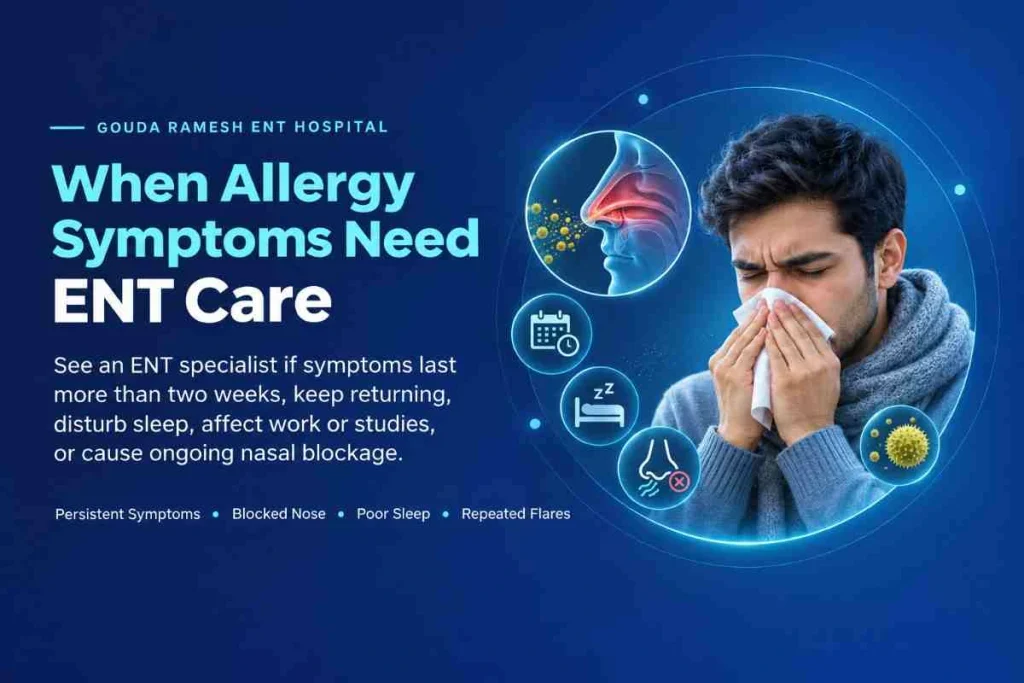
- Symptoms persist beyond two weeks, or keep coming back
- Over-the-counter medicines no longer control them
- You have been using a decongestant nasal spray for more than a week
- Nasal blockage is affecting your sleep, work or studies
- Your child is mouth breathing, snoring, or has repeated ear infections
- Facial pain, pressure or thick coloured discharge with fever suggests sinus infection
- Blockage is only on one side, or there is bleeding, which needs examination
Seek medical care urgently rather than waiting for an appointment if you have difficulty breathing, swelling of the face, lips or tongue, or a sudden severe reaction.
Allergic Rhinitis Consultation at Gouda Ramesh ENT Hospital
Allergic rhinitis is treatable, and most patients improve substantially once the trigger is identified and the right treatment is used correctly for long enough. At Gouda Ramesh ENT Hospital, assessment covers both the allergy and the structure of the nose, so that a deviated septum, enlarged turbinates or sinus disease are not missed and attributed to allergy alone.
Appointments are available at our Kukatpally, Hanamkonda and Chandanagar branches.
Frequently Asked Questions About Dust Allergy
How Do I Know If I Have a Dust Allergy or a Cold?
A cold tends to bring fever, body ache and a sore throat, and clears within about ten days. A dust allergy tends to bring itching and bursts of sneezing without fever, and follows a pattern — the same time each day, or in the same place. If symptoms have lasted more than two weeks without fever, allergy is the likelier explanation, though only an examination can confirm it.
Can allergic rhinitis be cured permanently?
It can be controlled very well, and immunotherapy can reduce the underlying sensitivity over time in suitable patients. For most people the realistic goal is long stretches with few or no symptoms, through trigger control and the right medication used properly.
Why do I sneeze only in the morning?
Overnight exposure to house dust mites in the mattress and pillow is a common reason. Mite-proof bedding covers and weekly hot washing often help.
Are antibiotics useful for allergic rhinitis?
No. Allergic rhinitis is not an infection, so antibiotics do nothing for it. They are needed only if a genuine bacterial infection develops on top of it.
Is allergic rhinitis contagious?
No. It cannot be passed to anyone else. The tendency to develop allergies does run in families, which is why several members of one household often have it.
Are nasal steroid sprays safe to use long term?
Used at prescribed doses with correct technique, intranasal steroid sprays have a good safety record and are very different from steroid tablets. Mild nasal dryness or occasional nosebleeds can occur. They should be reviewed periodically by your doctor, particularly for children. Decongestant drops are the ones not to use beyond a few days.
Can allergic rhinitis cause ear problems or hearing loss?
Swelling can block the eustachian tube and trap fluid behind the eardrum, which dulls hearing and is associated with repeated ear infections. In young children this matters particularly, because it can occur during the years speech is developing.
Does an air purifier help?
It may help with airborne particles such as pollen and pet dander. It does less for dust mites, which live in bedding and upholstery rather than floating in the air — so bedding measures usually matter more.
My child snores and breathes through the mouth. Is that allergy?
It may be. Persistent nasal allergy, enlarged adenoids, or both together are common causes. It is worth an ENT examination rather than waiting, because mouth breathing affects sleep and school performance.
Which doctor should I see for a dust allergy?
An ENT specialist is the right starting point when symptoms are mainly nasal, since the nose and sinuses need to be examined directly. Patients with significant asthma or multi-system allergy may also be referred to an allergy specialist.
Sneezing every morning for months?
It is treatable once the trigger is identified. Book an allergy assessment at Gouda Ramesh ENT Hospital.
Kukatpally +91 95505 74871 · Chandanagar +91 99851 71182 · Hanamkonda +91 91778 12783
Medically reviewed by Dr. Gouda Ramesh, MS (ENT)
Consultant ENT, Head & Neck Surgeon, Gouda Ramesh ENT Hospital, Hyderabad and Warangal. [CONFIRM: years of experience]
Written by the Gouda ENT content team and reviewed for medical accuracy before publication.
Published: [11/11/2026] · Last reviewed: [11/11/2026]
Scope and limitations. This article is general health information about allergic rhinitis in adults and children. It is not a diagnosis and does not replace an in-person consultation. Individual treatment varies with age, pregnancy, other medical conditions and medicines already being taken. All medicines mentioned require a doctor’s prescription and supervision; none should be started, stopped or changed on the basis of this article. If you have difficulty breathing or a sudden severe reaction, seek medical care immediately.
References
1. American Academy of Otolaryngology–Head and Neck Surgery Foundation. Clinical Practice Guideline: Allergic Rhinitis. entnet.org
2. American Academy of Family Physicians. AAO–HNSF Releases Guideline on Allergic Rhinitis. aafp.org